JUANCHO TORRES
Photojournalist
As Sad As Beautiful

Smoke rises from the southern Colombian jungle of Caqueta Department as seen from where members of the women demining team take part in a search for explosive ordnances in Milan, Colombia on February 17, 2020. The women demining team made up of 12 people, including 8 females, are taking their country back, one land mine at a time, the mines are unearthed by hand and they spend hours on their knees looking for them, to make their country safer.

Members of the demining team Humanicemos (former FARC) takes part in a search for explosive ordnances at the southern Colombian jungle of Caqueta Department in Montanita, Caqueta, Colombia on September 26, 2021.

The Serranía de Manacacías is under increasing environmental threat. Awaiting official protection, the region is crucial for biodiversity conservation and urgently needs safeguarding.
Smoke rises from the southern Colombian jungle of Caqueta Department as seen from where members of the women demining team take part in a search for explosive ordnances in Milan, Colombia on February 17, 2020. The women demining team made up of 12 people, including 8 females, are taking their country back, one land mine at a time, the mines are unearthed by hand and they spend hours on their knees looking for them, to make their country safer.
Long-term project documenting photographs taken between 2017 and 2025


Colombia's Landmine Legacy
In Colombia, landmines are still part of everyday life. They lie hidden along footpaths, farms, riverbanks, and forest trails—silent reminders of a war that never fully ended. These devices mark territories shaped by narcotrafficking, guerrilla fronts, paramilitary control, criminal gangs, and the growing pressure of illegal mining driven by the search for gold and other minerals.
The conflict here is not only about drugs. After more than fifty years of a so-called war on drugs that has failed, new forms of extractivism continue to fuel violence and displacement. Illegal mining poisons rivers and fragments communities, while legal oil operations leave environmental scars that will last for generations. Landmines remain behind to protect routes, resources, and profit—long after armed groups move on.
All of this unfolds in one of the most biodiverse countries in the world. Places of extraordinary beauty coexist with fear and uncertainty. Walking, farming, fishing, or simply crossing a field can become an act of risk. This photo essay looks at how landmines shape daily life, memory, and movement, revealing a conflict that survives quietly—underfoot, in the land, and in the lives of those who remain.
Por la memoria del camino, la fuerza del presente y lo que continúa.
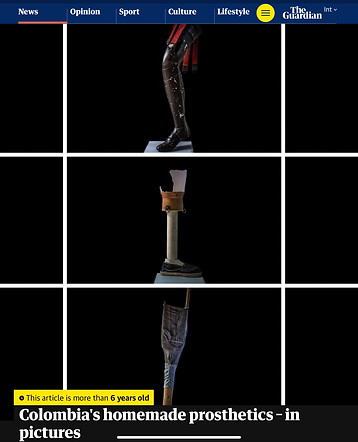
Since 1992, more than 11,500 Colombians have been killed or injured by landmines, a legacy of more than 50 years of internal conflict. Many impoverished amputees without access to the healthcare system have resorted to making homemade prosthetics from wood, leather, metal and plastic bottles.
A photo series work that secured the second place in the 'News Series' category at the Pictures of the Year Latin America (POY LATAM) 2019